How to Build a Startup Marketing Plan in 8 Easy Steps
If you’re a startup founder or small business owner, you’ve likely heard the saying: “Failing to plan is planning to fail.” This rings especially true in marketing.
A well-crafted marketing plan is the roadmap that guides your business growth – and without it, your marketing efforts can become scattered, wasteful, or ineffective.

In fact, 75% of small businesses have a marketing plan, and those that do are 6.7 times more likely to report success than those without one (SimpleTexting).
The message is clear: creating a marketing plan is not just a nice-to-have, it’s a necessity for success. But how do you actually build a startup marketing plan? If you’ve never done it before, it can feel intimidating.
The good news is, it doesn’t have to be a 100-page formal document. For a startup or SME, a lean, focused plan that you actually use is far more valuable than a bulky binder that gathers dust.
In this step-by-step guide, we’ll walk you through how to create a marketing plan tailored to your small business – from setting goals to budgeting to choosing the right tactics. By the end, you’ll have a clear blueprint for your marketing activities and the confidence to execute it.
Step 1: Define Your Marketing Objectives
Every great plan starts with clear goals. What exactly do you want your marketing to achieve? Setting specific, measurable objectives will focus your efforts and later help you gauge success. Use the SMART criteria (Specific, Measurable, Achievable, Relevant, Time-bound) to frame your objectives. For example:
- Increase website traffic by 50% in the next 6 months. (This is specific and measurable – you can track via Google Analytics, and it’s time-bound to 6 months.)
- Generate 100 qualified leads by the end of Q3. (Another concrete goal, assuming you define what a “qualified” lead is for your business.)
- Boost online sales revenue by 30% this year.
Aim for 2-3 main objectives; too many goals can dilute your focus. Ensure they align with your overall business goals. If you’re a startup aiming for rapid user acquisition, your marketing objectives might revolve around lead generation and brand awareness.
If you’re an SME looking to increase profitability, objectives might focus on improving conversion rates or upselling existing customers.
It’s worth noting how vital having these goals is. According to research, 87% of small businesses with a marketing plan (and thus clear objectives) report successful marketing outcomes, versus only 13% success among those without a plan (SimpleTexting).
That’s a huge gap. By simply articulating your targets, you’re already ahead of many competitors. So write down those goals – they will drive every decision in your marketing plan.
Step 2: Know Your Audience (Target Market and Personas)
Marketing is pointless if it’s not reaching the right people. The second step is to clearly define who your target customers are. For startups, this might be something you’re still refining, and that’s okay. Start with broad strokes and narrow down as you get more data. Here’s how to approach it:
- Identify Your Target Market: These are the broad groups of people or businesses you serve. For example, “tech-savvy millennials in urban areas who need affordable fitness solutions” or “small retail business owners looking to sell online.” Consider demographics (age, gender, location), firmographics for B2B (industry, company size), and any niche characteristics.
- Create Buyer Personas: Personas are semi-fictional profiles that represent your ideal customers. Give them a name and backstory. E.g., “Startup Steve – a 32-year-old fintech founder who struggles with marketing because he’s focused on product development. He wants efficient, no-nonsense solutions and has a modest budget.” Outline their goals, pain points, and where they hang out (online or offline). What motivates their purchasing? What problems are you solving for them?
Why do this? Because effective marketing speaks directly to the audience’s needs and desires. If you know pain points, you can craft messages that address them.
When defining your audience, use any data you have: customer surveys, social media insights, Google Analytics demographics, etc. And if you’re new and don’t have customers yet, research who your competitors target or look at industry reports for clues.
The goal is to avoid generic “our services are for everyone!” marketing. Instead, be specific – it helps you cut through the noise and resonate with those who matter most to your business.
(Insight: Only 23% of small businesses leverage a blog to engage audiences (SimpleTexting); one reason could be not knowing what content their audience wants. By having clear personas, you’ll also have clearer content ideas for blogging, social media, and more.)
Step 3: Analyse the Competition
No business exists in a vacuum. Understanding your competition can provide invaluable insights for your marketing plan. Competitor analysis doesn’t have to be complex for a startup – even a simple matrix of your top 3-5 competitors is useful. Here’s what to look at:
- Who are your competitors? List direct competitors (those offering similar products/services to the same audience) and indirect ones (those solving the same customer problem in a different way). For example, a local cafe’s direct competitors are other cafes; indirect competitors might be Starbucks or even a grocery store (people buying coffee to brew at home).
- Competitors’ Strengths & Weaknesses: What do they do well? Look at their marketing presence: Is their website high-quality? Do they rank well on Google for certain keywords? Are they active on social media with good engagement? Note these as strengths. Also identify weaknesses – perhaps they have poor customer reviews about service, or their content is outdated, or they don’t cater to a segment you could target.
- Their USPs and Messaging: How do competitors position themselves? If each competitor has a slogan or tagline, what is it? This tells you how they differentiate. Maybe one competes on price, another on quality, another on innovation. Knowing this helps you find a unique angle for yourself.
- Marketing Channels Used: Observe where and how competitors market. Do they run Google Ads? Are they big on LinkedIn or TikTok? Do they appear at industry events or get mentioned in press? If you see, for example, all major competitors heavily investing in SEO content (ranking on many search terms), that’s a battlefield you might need to engage in. Or if none are doing much on a certain channel that your audience uses, that’s an opportunity to stand out.
A quick way to do competitive analysis is to Google keywords related to your business and see who pops up (both in ads and organic results). Check their websites for clues – many will have a “Clients” or “Case Studies” page, which shows their focus, or a blog which reveals their content strategy.
Even reading customer reviews (on Google, Facebook, etc.) for competitors can highlight what customers value or complain about.
After gathering this info, summarise it. You might make a simple table like:
- Competitor A: Strengths (big ad budget, strong brand recognition), Weaknesses (outdated website, slow support).
- Competitor B: Strengths (great SEO, thought leadership via blog), Weaknesses (expensive, not focused on small clients).
- etc.
From this, identify your opportunity: what gap can you fill or what strength can you leverage? Maybe you’ll realise “none of these competitors specifically cater to startups – they all talk enterprise.” That could be your niche to own in your messaging (and indeed Three Bridges aims at startups/SMEs).
Or you might see a competitor dominating Google search for certain topics, and decide to target different keywords where they’re not present.
This step ensures your marketing plan is grounded in reality – you know the battlefield and can position yourself to win in areas that are under-served or where you have an edge.
Step 4: Craft Your Core Marketing Messages (Brand Story & USP)

With your audience and competition in mind, you can now articulate what your brand stands for and how you’ll communicate it.
This is about defining your Unique Selling Proposition (USP) and key messages.
Your USP is the concise statement of what makes you different and valuable to your target customer. It’s the heart of your marketing plan, because it will influence all your campaigns and content.
For example, a clean beauty skincare brand might have a USP like: “Luxurious, all-natural skincare powered by science, designed for sensitive skin without harmful chemicals.”
That encapsulates a few differentiators (clean ingredients, science-backed formulations, targeted for sensitive skin).
To craft your USP, think about the overlap of:
- What your target customer needs/values (e.g., natural ingredients, effective results, cruelty-free, dermatologist-approved).
- What you do well (your strengths, such as innovative formulas, sustainability, or affordability).
- What competitors are not saying (to find a fresh angle, such as emphasising a particular hero ingredient or clinical testing results).
Once you have the USP, break it down into core messages or value propositions. These are like supporting pillars that add detail.
For instance:
- “Pure & Gentle Ingredients” – emphasising that your skincare is free from sulfates, parabens, and synthetic fragrances, making it safe for sensitive skin.
- “Science-Backed Results” – showcasing research, dermatologist testing, and proven ingredients that deliver visible improvements.
- “Sustainability at Our Core” – highlighting eco-friendly packaging, ethical sourcing, and cruelty-free certification.
These messages will appear in your marketing collateral: your website copy, your social media bios, your elevator pitch, and tone of all communications. Ensure consistency – the marketing plan should set the tone that you carry through.
If your brand voice is educational and empowering (which resonates with skincare enthusiasts), that should be noted in the plan so everyone involved in marketing keeps it in mind.
Also consider your brand story: people love narratives. Even a brief story of why your business exists can be powerful. Example: “We launched our clean beauty brand after struggling to find effective skincare that didn’t irritate sensitive skin.
Our founder, (that's you!), a skincare expert with a background in dermatology, set out to create a brand that combines natural ingredients with proven science to nourish and protect even the most delicate skin.” – A story like that can make a brand relatable and memorable. In your plan, jot down the key points of your story that should shine through in marketing.
Step 5: Choose Your Marketing Channels and Tactics
Now we get to the meat of the plan: which marketing strategies and channels will you use to reach your audience and achieve the objectives set in Step 1.
There are numerous marketing channels available, but as a startup or SME, you want to pick those that offer the best bang for your buck and align with your audience habits (identified in Step 2).
Let’s break down common channels and considerations:
- Website & SEO: Your website is your home base. Ensuring it’s optimised for search engines (SEO) is key for being found. If one of your goals is to increase organic traffic, then tactics here include keyword research (which keywords do you want to rank for?), on-page optimisation (making sure your page titles, meta descriptions, and content include those keywords naturally), and possibly content creation (like blogging) to target additional keywords.
- Content Marketing: This overlaps with SEO but also includes other content like videos, infographics, or downloadable guides. Content marketing is about providing value to attract and retain customers. For a startup, a smart tactic is to create cornerstone pieces that establish authority (e.g., an e-book or an ultimate guide relevant to your industry) and then smaller pieces (blogs, social posts) that draw from it.
- Social Media Marketing: Choose platforms that your target audience uses. It’s better to excel on 1-2 platforms than stretch thin across all. If you’re B2B or targeting professionals, LinkedIn might be prime. If you’re consumer-focused and visual, Instagram or TikTok. Outline how you’ll use social: posting frequency, content themes, and growth strategies.
- Email Marketing: Building an email list is highly valuable (it’s a direct line to interested prospects or customers). Tactics include having a newsletter, sending regular updates or special offers, or drip email sequences for new sign-ups. For startups, even a simple monthly newsletter with a useful tip or update can keep you on people’s radar.
- Paid Advertising (PPC): This includes Google Ads, Facebook/Instagram Ads, LinkedIn Ads, etc. Paid ads can yield quick results, but you need to be careful with budget. In your plan, decide if paid acquisition is a core part of your strategy or something you’ll test lightly. For example, a startup might allocate a small budget for Google Ads on key search terms if immediate lead generation is critical, or for social ads to boost brand awareness in a specific launch period.
- Networking and Partnerships: Not all marketing is online. Especially for local or niche startups, consider events, trade shows, or partnerships. For instance, partnering with a complementary business to do co-marketing can expand reach. Or attending startup meetups to pitch your services. In your plan, list any key events or partnership ideas. Example: “Partner with the local Chamber of Commerce to offer a free marketing workshop (gains exposure to SMEs in the community and establishes credibility).”
- Public Relations (PR): This might involve reaching out to local newspapers, industry blogs, or influencers to get coverage or mentions. Startups with a good story (like a unique product or milestone) can sometimes get free press. Tactic: “Send a press release to tech news sites when we launch our new platform – goal to get 2 media mentions in industry blogs.” PR is less controllable, but if it’s a part of your growth strategy, note the key actions.
- Referrals and Word-of-Mouth: Especially for service businesses, encouraging existing happy clients to refer others is powerful. Tactics: “Implement a referral program – e.g., existing customers get 1 month free service for each referral that becomes a client.” If you’re a new startup, you might rely on word-of-mouth; you can still plan activities to stimulate it (like offering an incentive for testimonials or referrals).
List out which channels you’ll use and, importantly, why they make sense for your business. Also consider your bandwidth – it’s better to choose a few channels and do them well than try to do everything poorly.
If you’re a solo founder, maybe you decide: Okay, our main efforts will be on SEO/content and LinkedIn, with a bit of Google Ads. Then your plan details those, and you deliberately set aside others for later.
Step 6: Set Your Marketing Budget
Now that you know what you want to do, ask: what will it cost? For each channel or tactic in your plan, you should allocate a portion of your marketing budget. Budgeting helps ensure you don’t overspend and also lets you estimate potential ROI.
If you’ve never set a marketing budget, a common benchmark is to allocate a percentage of revenue (for small businesses, often 5-10% of revenue is suggested). However, startups might operate differently (perhaps spending based on investment funds or desired growth).
Interestingly, 47% of small businesses spend less than €10,000 per year on digital marketing (BusinessDasher), and on average about 8% of revenue is spent on marketing. Knowing this, you can gauge where you stand – maybe you decide to invest a bit more to outpace slower competitors, or you match the norm because funds are tight.
Break down the budget by category:
- Fixed costs: e.g., marketing tools (email software subscription, SEO tool, design tools), website hosting, etc. These are predictable each month.
- Content production costs: if you outsource blog writing or video creation, include those. If you do it yourself, this might be more of a time investment than direct cost (but remember time is money too – but for budgeting, focus on actual expenditures).
- Ad spend: list planned spend for Google Ads, social ads, etc., per month or for the year.
- Events/PR: any costs for sponsorships, attending conferences, sending out press releases (some distribution services cost money), etc.
- Agency or Freelancer fees: if you plan to hire help (could be a part-time social media manager, or engaging a marketing agency like Three Bridges for consulting – shameless plug!), include those fees.
Using a simple table or our Marketing Budget Tracker (Resource 3 from Stage 2) can be very handy here. In fact, consider using that tool: input your planned spend across channels and ensure it aligns with what you can afford. The tool will also help later to track actual spend and ROI per channel.
Make sure your budget aligns with your earlier steps. For example, if SEO is a big tactic, budget for an SEO tool or a content writer. If you’re focusing on social media, maybe allocate some budget for a scheduling tool or some ad spend to boost important posts.
If your budget is extremely limited, emphasise the free/low-cost tactics (content, SEO can be low cost if done in-house, partnerships, etc.) and be conservative on paid tactics.
Document your budget assumptions. For instance:
- “Total marketing budget for 2025: €12,000. This will be roughly divided as 40% content/SEO, 30% paid ads, 20% events/PR, 10% tools.” – whatever breakdown suits your plan.
- If you expect certain costs only in certain months (e.g., a big campaign in September for a holiday push), note that.
By setting this budget in the plan, you can later measure ROI properly. It’s also a reality check – if you listed a ton of tactics in Step 5 and the budget reveals you can’t fund all those, you might trim some now.
Better to have a realistic, prioritised plan than an over-ambitious one that you can’t execute due to funds.
Step 7: Define Metrics and KPIs (How Will You Measure Success?)
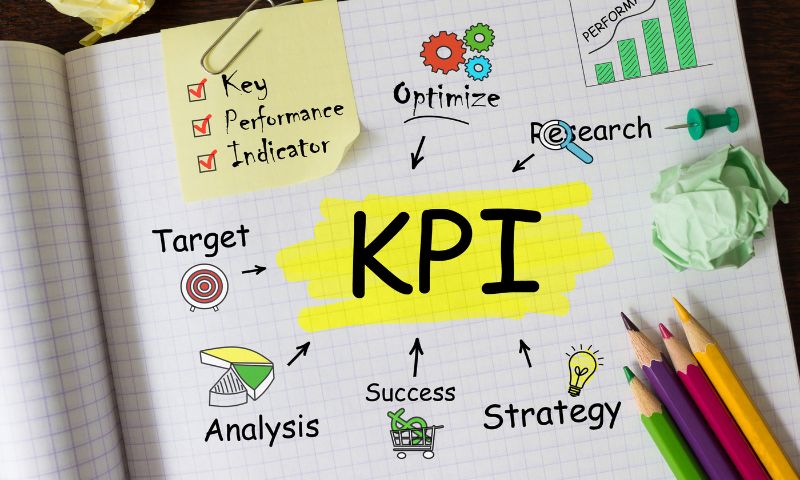
A marketing plan isn’t complete without specifying how you’ll track progress. Remember those objectives from Step 1? Now you determine the Key Performance Indicators (KPIs) that tell you if you’re on track to meet them, and other metrics for each channel.
For each objective, list a KPI:
- Objective: Increase website traffic 50% in 6 months. -> KPI: Monthly website sessions (from Google Analytics). If you have 1,000 sessions now, target 1,500 in 6 months. You might also break it down by channel (e.g., organic search traffic KPI).
- Objective: Generate 100 leads by Q3 -> KPI: Number of leads (perhaps measured by contact form submissions, or sign-ups if you have a sign-up funnel). That breaks down to ~33 leads per month as a checkpoint.
- Objective: Boost online sales by 30% -> KPI: e-commerce sales or total revenue from online, tracked monthly.
Next, metrics by channel/tactic:
- SEO/Content metrics: Organic traffic, keyword rankings (e.g., track 5-10 important keywords to see if they move up), number of blog impressions/clicks from search (Google Search Console data). Also engagement metrics like average time on page for your blog articles (indicating people read them).
- Social media metrics: Followers count is a vanity metric but still track it as an indicator of reach. More importantly, track engagement (likes, comments, shares) per post, and referral traffic from social to your site. If running ads, track click-through rate (CTR) and conversion from those ads.
- Email metrics: Open rates, click-through rates on your emails, and unsubscribe rates. If you use email for lead nurturing, track how many emails convert readers into taking an action (like clicking to your site or signing up for something).
- Paid ads metrics: CTR, Conversion Rate (if you have conversion tracking set up – e.g., how many of those who clicked actually filled a form or purchased), Cost Per Click (CPC), and Cost Per Acquisition (CPA). For example, if a Google Ad costs €2 per click and you convert 1 in 20 clicks to a lead, your CPA is €40/lead.
- Overall ROI: Using the Budget & ROI Tracker, monitor how much revenue or value you’re getting versus what you spend. If direct revenue is hard to attribute (common in marketing), use proxies like number of leads (and then if you know what a lead is roughly worth, you can estimate ROI). Tools like Google Analytics’ Goals or a CRM can help attribute revenue to marketing sources.
Set up a simple reporting cadence. Maybe you’ll do a monthly check-in on key metrics and a bigger quarterly review to adjust the plan. Write into the plan: “We will review KPIs monthly.
If website traffic is below target for 2 consecutive months, we will re-evaluate SEO tactics (perhaps increase content output or adjust keywords).” Having these pre-thought-out triggers is useful for agile marketing.
Also, keep a realistic perspective: some tactics take time. SEO might be slow initially (it’s common not to see big jumps for several months), whereas PPC you can evaluate within weeks. So, set interim milestones if needed (e.g., “By month 3, want to see at least 20% of target traffic increase, by month 6 hit 50%”).
Step 8: Action Plan and Implementation Schedule
The final piece is turning this plan into action. List out the key activities and assign responsibilities and timelines. For a very small team or solo founder, this could be as simple as a calendar of what to do when. For example:
- Week 1 of January: Finalise marketing plan (you’re doing that now!), set up Google Analytics and Search Console for tracking.
- January: Redesign website homepage messaging to align with core messages (if needed), create content calendar for Q1.
- February: Publish first blog post (topic XYZ), start email newsletter.
- March: Launch referral program for existing clients.
- etc.
This schedule ensures you actually implement the things in your plan. You can tie activities to goals (e.g., “to achieve objective X, we will do Y by date Z”). Use project management tools or even a simple spreadsheet to map this out.
It’s also wise to include any contingency plans or ideas backlog. For instance, “If by mid-year we have met Goal A early, we will shift additional budget to Goal B or experiment with [new channel].”
Or “If tactic X isn’t yielding results by June, consider consulting a marketing expert or agency for adjustments.” This shows you’re ready to iterate – an important mindset in marketing.
Finally, get buy-in. If you have a team or a partner, review this plan with them. Everyone should be on the same page. If it’s just you, consider running it by a mentor or advisor for feedback. It’s easier to tweak a plan at the start than to pivot blindly later.
Conclusion & Next Steps:
You now have a startup marketing plan that outlines where you’re going and how to get there. Remember, a plan is a living document – don’t file it away and forget it. Use it as a reference each week: are the things you’re doing aligning with the plan?
As new opportunities or challenges arise (and they will), update the plan. Perhaps a new social media platform takes off, or a marketing tactic isn’t as effective as hoped – adapt and adjust the plan sections accordingly.
In the world of startups, agility is an advantage. Your marketing plan provides structure, but it shouldn’t be rigid. Think of it as a lighthouse guiding you, but you can still navigate around storms as needed.
External sources:
- Small biz with a marketing plan are far more successful (The state of small business marketing in 2024 - SMS Marketing & Text Marketing Services – Try It For Free) – evidence that planning pays off.
- Nearly half of small businesses keep marketing in-house while also using agencies, a hybrid approach that 2.5x improves success (The state of small business marketing in 2024 - SMS Marketing & Text Marketing Services – Try It For Free) – meaning don’t hesitate to get external expertise to complement your efforts.